

An Alpine Mortgage analysis of the 2026 FHFA and HUD county-level loan limit datasets
For the first time in recent memory there are 24 US counties in 2026 where an FHA-eligible borrower can finance more on a single family home than a conventional conforming borrower in the same county. The gap is $39,375, and the affected counties are almost entirely in the New York City Metropolitan Area: all 12 New Jersey counties in the NYC Metro ceiling tier, all 10 New York counties in the NYC Metro ceiling tier, plus Garfield and Pitkin counties in Colorado.
The gap is the result of a quirk in how the Federal Housing Finance Agency (FHFA) and the U.S. Department of Housing and Urban Development (HUD) apply different rules to the same underlying home price data. This page identifies every US county where the 2026 FHA loan limit exceeds the 2026 conforming loan limit for a one unit property, explains the policy mechanism that creates the gap, and outlines what it means for buyers in the affected counties.
The 24 affected counties
Based on Alpine Mortgage’s analysis of the 2026 FHFA conforming loan limits (announced November 25, 2025) and the 2026 HUD FHA loan limits (announced December 11, 2025 via Mortgagee Letter 2025-23), the following 24 US counties have a 2026 FHA loan limit higher than the 2026 conforming loan limit for a one unit property. In all 24 counties, the 2026 FHA limit is $1,249,125, the 2026 conforming limit is $1,209,750, and the gap is $39,375.
| County | State | Region | FHA 2026 | Conforming 2026 | Gap |
| Bergen County | NJ | NYC Metro | $1,249,125 | $1,209,750 | +$39,375 |
| Bronx County | NY | NYC Metro | $1,249,125 | $1,209,750 | +$39,375 |
| Essex County | NJ | NYC Metro | $1,249,125 | $1,209,750 | +$39,375 |
| Garfield County | CO | I-70 Mountain Corridor | $1,249,125 | $1,209,750 | +$39,375 |
| Hudson County | NJ | NYC Metro | $1,249,125 | $1,209,750 | +$39,375 |
| Hunterdon County | NJ | NYC Metro | $1,249,125 | $1,209,750 | +$39,375 |
| Kings County (Brooklyn) | NY | NYC Metro | $1,249,125 | $1,209,750 | +$39,375 |
| Middlesex County | NJ | NYC Metro | $1,249,125 | $1,209,750 | +$39,375 |
| Monmouth County | NJ | NYC Metro | $1,249,125 | $1,209,750 | +$39,375 |
| Morris County | NJ | NYC Metro | $1,249,125 | $1,209,750 | +$39,375 |
| Nassau County | NY | NYC Metro (Long Island) | $1,249,125 | $1,209,750 | +$39,375 |
| New York County (Manhattan) | NY | NYC Metro | $1,249,125 | $1,209,750 | +$39,375 |
| Ocean County | NJ | NYC Metro | $1,249,125 | $1,209,750 | +$39,375 |
| Passaic County | NJ | NYC Metro | $1,249,125 | $1,209,750 | +$39,375 |
| Pitkin County | CO | I-70 Mountain Corridor | $1,249,125 | $1,209,750 | +$39,375 |
| Putnam County | NY | NYC Metro (Lower Hudson) | $1,249,125 | $1,209,750 | +$39,375 |
| Queens County | NY | NYC Metro | $1,249,125 | $1,209,750 | +$39,375 |
| Richmond County (Staten Island) | NY | NYC Metro | $1,249,125 | $1,209,750 | +$39,375 |
| Rockland County | NY | NYC Metro (Lower Hudson) | $1,249,125 | $1,209,750 | +$39,375 |
| Somerset County | NJ | NYC Metro | $1,249,125 | $1,209,750 | +$39,375 |
| Suffolk County | NY | NYC Metro (Long Island) | $1,249,125 | $1,209,750 | +$39,375 |
| Sussex County | NJ | NYC Metro | $1,249,125 | $1,209,750 | +$39,375 |
| Union County | NJ | NYC Metro | $1,249,125 | $1,209,750 | +$39,375 |
| Westchester County | NY | NYC Metro (Lower Hudson) | $1,249,125 | $1,209,750 | +$39,375 |
Source: Alpine Mortgage analysis of the FHFA Conforming Loan Limit Values for Calendar Year 2026 (HERA-based, published November 25, 2025) and HUD Mortgagee Letter 2025-23, 2026 Nationwide Forward Mortgage Loan Limits (published December 11, 2025). Verified against HUD’s county-level FHA mortgage limits lookup tool.
Try the calculator: Alpine Mortgage 2026 Conventional & FHA Loan Limits Calculator displays both limits side-by-side for any US county.
The story is mostly about the NYC Metro Area
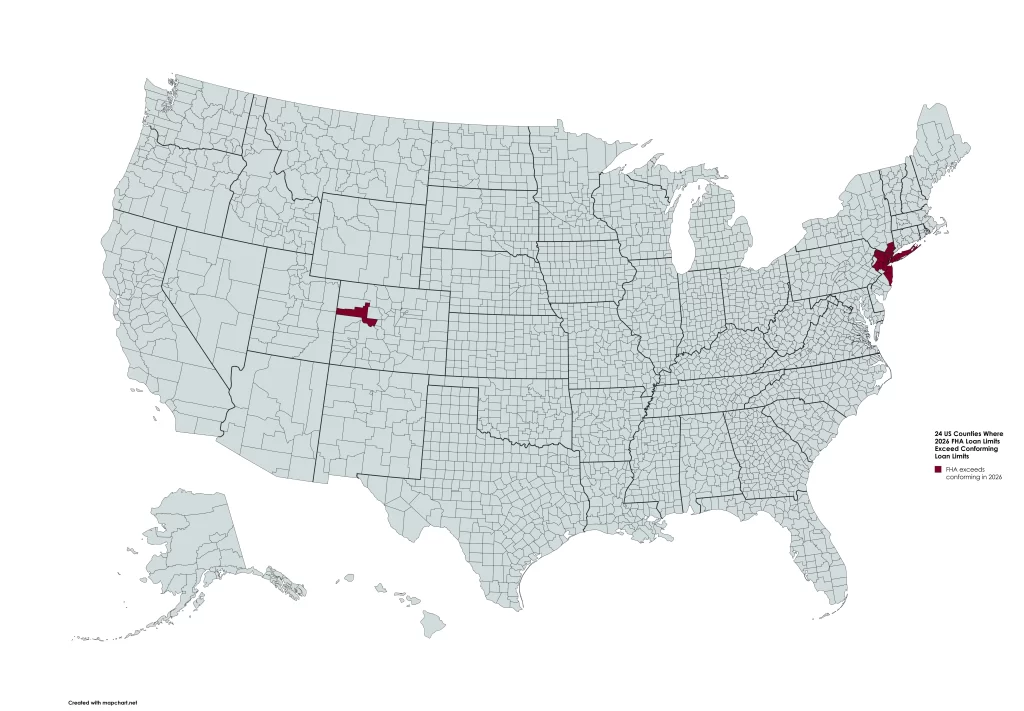
Of the 24 affected counties, 22 are in the New York-Newark-Jersey City Metropolitan Statistical Area: all 12 New Jersey counties in the NYC Metro ceiling tier (Bergen, Essex, Hudson, Hunterdon, Middlesex, Monmouth, Morris, Ocean, Passaic, Somerset, Sussex, Union) and all 10 New York counties in the NYC Metro ceiling tier (the five New York City boroughs plus Nassau, Suffolk, Westchester, Rockland, Putnam).
These 22 NYC Metro counties cover one of the largest housing markets in the United States by population and transaction volume. The combined population of the affected NYC Metro counties exceeds 18 million people. For buyers in the $1,209,750 to $1,249,125 loan amount range across this region, the gap is meaningful.
The remaining two affected counties are Garfield and Pitkin counties in Colorado, both in the I-70 mountain resort corridor anchored by Aspen, Snowmass Village, Glenwood Springs, and Carbondale. A third Colorado county, Eagle, was at the 2025 conforming ceiling but moved up to the new 2026 ceiling of $1,249,125 along with both FHA and conforming, so it does not appear in the gap.
Why this gap exists: FHFA’s hold harmless rule
The 2026 FHA ceiling and the 2026 conforming ceiling are both statutorily set at $1,249,125 for a one unit property, representing 150% of the national baseline conforming loan limit of $832,750. In theory, no county should have an FHA limit higher than its conforming limit, since the FHA ceiling and the conforming ceiling are the same dollar figure.
In practice, FHFA’s hold harmless rule creates the gap. Under the Housing and Economic Recovery Act of 2008 (HERA), FHFA cannot reduce a county’s conforming loan limit even when local median home prices decline or fail to keep pace with the broader market. When the formula calculation would produce a lower limit for a county in a given year, FHFA holds the limit at the prior year’s level.
In 2025, the conforming high cost ceiling was $1,209,750. In 2026, the new statutory ceiling moved up to $1,249,125, a $39,375 increase. Most ceiling counties, including all of California’s Bay Area, Los Angeles, Orange County, Hawaii, DC, Eagle County in Colorado, and a number of others, saw their conforming limit move up to the new $1,249,125 ceiling. But the entire NYC Metro ceiling tier, plus Pitkin and Garfield in Colorado, did not. In these 24 counties, the FHFA formula did not support an increase from the prior year, so the conforming limit was held at $1,209,750.
HUD’s FHA program operates under a different statutory framework, the National Housing Act. For these 24 counties, HUD’s FHA methodology produced a 2026 ceiling at $1,249,125 rather than holding at the prior year’s level, creating the gap.
The result: in the 24 affected counties, FHA borrowers can finance $39,375 more than conventional borrowers on a one unit purchase. Proportionally similar gaps apply to 2 unit, 3 unit, and 4 unit properties.
What this means for buyers in the affected counties
For most buyers, the FHA-exceeds-conforming gap is a curiosity rather than a material financial decision. Conventional financing generally offers better rates, lower mortgage insurance costs, and more flexible terms than FHA financing, so a conventional loan at $1,209,750 is typically preferable to an FHA loan at $1,249,125 for borrowers who qualify for both.
The gap matters specifically for buyers in the $1,209,750 to $1,249,125 loan amount range who would not otherwise qualify for conventional financing. These are typically borrowers with:
- Credit scores between 580 and 700 who would face higher conventional rates or risk denial
- Debt-to-income ratios above the 45% conventional limit but below the FHA limit of 57%
- Down payments between 3.5% and 5%, where FHA’s 3.5% minimum gives access without requiring 5% conventional down or 20% down to avoid private mortgage insurance
- Recent credit events (bankruptcy, foreclosure, short sale) that disqualify them from conventional financing within FHA’s seasoning periods
For these buyers across the NYC Metro Area and the Colorado I-70 corridor, the $39,375 gap can be the difference between financing a target property and being shut out of the market. In NYC Metro counties specifically, where median single family home prices in Bergen, Hudson, Westchester, and Nassau regularly exceed $1 million, the gap directly affects accessibility for the credit constrained or down payment constrained buyer segment that anchors first-time homebuyer demand in the region.
Expert commentary from Steven Parangi, founder of Alpine Mortgage and a licensed attorney and mortgage loan originator with over 20 years of experience: “Having FHA actually exceed conforming across the entire NYC Metro Area in 2026 is the most consequential application of the hold harmless rule I’ve seen. For borrowers in Bergen, Hudson, Westchester, Long Island, or anywhere across the affected counties who would have been pushed into jumbo financing for an extra $30,000 to $40,000 in loan amount, FHA now offers a meaningful alternative. The gap is narrow but the affected buyer pool is large.”
Why 22 NYC Metro counties got held harmless while California, Hawaii, and DC moved up
The NYC Metro Area’s hold harmless outcome reflects a real divergence in 2024-2025 home price movement between the New York metro and other high-cost US housing markets. While the FHFA House Price Index recorded a 3.26 percent national increase in average home values between Q3 2024 and Q3 2025, the increase was not evenly distributed.
The Bay Area, Los Angeles-Orange, Hawaii, Washington DC, and the Massachusetts islands all recorded sufficient local home price growth to support an increase from the 2025 conforming ceiling of $1,209,750 to the new 2026 ceiling of $1,249,125. The full list of counties that moved up to the new $1,249,125 ceiling includes the 10 California Bay Area and LA-Orange ceiling counties, the entire state of Alaska, three Hawaiian counties, Eagle County in Colorado, the District of Columbia, Honolulu, Charles, Frederick, Montgomery, and Prince George’s counties in Maryland, Dukes and Nantucket in Massachusetts, all the DC-Northern Virginia commuter counties, Jefferson County in West Virginia, Teton County in Wyoming, Teton County in Idaho, Guam, and the U.S. Virgin Islands.
The NYC Metro ceiling counties, plus Pitkin and Garfield in Colorado, did not record enough local home price appreciation to support an increase. The FHFA formula calculation either matched or fell below the prior year’s $1,209,750 limit, triggering the hold harmless protection. The result is the unusual 2026 outcome where the largest metropolitan housing market in the country has a conforming loan limit $39,375 below its FHA loan limit.
Historical context: how often this happens
FHA limits exceeding conforming limits at the ceiling tier has been extremely rare historically. The two programs use different formulas but converge at the same statutory ceiling, and in most years both programs apply the same ceiling in the same counties at the same time. The 2026 occurrence is tied to the slowdown in home price appreciation in specific high cost markets, particularly the NYC Metro Area, through 2024 and 2025.
A buyer or industry professional researching the 2026 FHA-exceeds-conforming gap should not necessarily expect the same gap to persist in 2027. Once 2026 home price data flows through into the 2027 FHFA House Price Index calculations and the new conforming ceiling is established, the hold harmless mechanism either resolves the gap in some counties or potentially produces it in a different set of counties. The NYC Metro Area’s 2026 price trajectory will determine whether the same 22 NYC Metro counties remain in the same position next year.
Implications for the housing market and policy observers
The 2026 FHA-exceeds-conforming gap is a useful illustration of three policy realities worth considering:
Hold harmless protects borrowers but creates anomalies. FHFA’s hold harmless rule was designed to prevent disorderly contractions in the conforming market when home prices decline. It has worked as intended for nearly two decades. The unusual 2026 outcome where FHA exceeds conforming across the NYC Metro Area is a side effect of that protection, not a policy failure, but it illustrates how the two parallel federal mortgage programs can drift in unexpected ways when housing markets soften unevenly across regions.
FHA’s countercyclical role becomes more pronounced in slowing markets. FHA was created to provide mortgage access when private capital pulled back. The 2026 gap demonstrates that role in miniature: in counties where conventional limits did not grow with the statutory ceiling, FHA’s automatic alignment with the new ceiling preserves borrower access at the higher amount.
The NYC Metro is structurally separating from the rest of the high cost housing market. When the largest metropolitan housing market in the country fails to support a conforming limit increase while the Bay Area, LA, Hawaii, and DC all do, that is a meaningful data point about regional housing market trajectories. Policy observers tracking the geography of the affordability crisis should note that the NYC Metro Area’s softer 2024-2025 price growth, relative to other US high cost markets, is now reflected in federal lending limits.
Methodology
Alpine Mortgage compared the 2026 FHA loan limits announced by HUD on December 11, 2025 in Mortgagee Letter 2025-23 against the 2026 conforming loan limits announced by FHFA on November 25, 2025, for all 3,235 US counties and county equivalents in the FHFA HERA-based dataset. Counties were verified against HUD’s county-level FHA mortgage limits lookup tool to confirm the FHA limit is at the new 2026 ceiling of $1,249,125. Counties where the conforming limit was held at the 2025 ceiling of $1,209,750 but the FHA limit moved to the 2026 ceiling of $1,249,125 are the FHA-exceeds-conforming counties. The data underlying this analysis powers the Alpine Mortgage Conventional and FHA Loan Limits Calculator.
Sources
- FHFA News Release: Conforming Loan Limit Values for 2026, November 25, 2025
- FHFA 2026 Conforming Loan Limit Values, All Counties (Excel)
- HUD News Release: 2026 FHA Loan Limits, December 11, 2025
- HUD Mortgagee Letter 2025-23: 2026 Nationwide Forward Mortgage Loan Limits
- HUD FHA Mortgage Limits Lookup Tool
- Housing and Economic Recovery Act of 2008 (HERA), Public Law 110-289
Related Alpine Mortgage research
For the underlying county-level data powering this analysis, see Alpine Mortgage’s 2026 Conventional and FHA Loan Limits Calculator, which displays both limits side by side for every US county.
About the Author
Steven Parangi is a licensed mortgage loan originator (NMLS #76024) and attorney with over 20 years of experience in residential home lending. As the founder of Alpine Mortgage, Steven works directly with borrowers to review their mortgage options and assist them throughout the home financing process. Content published on AlpineBanker.com is reviewed regularly by Steven to reflect current lending guidelines and market conditions. View full author profile.
Media inquiries
Reporters and analysts covering the 2026 FHA and conforming loan limits, FHFA’s hold harmless rule, or the NYC Metro Area housing market may contact Alpine Mortgage for additional commentary or analysis. Email [email protected] or call (201) 488-8809.