

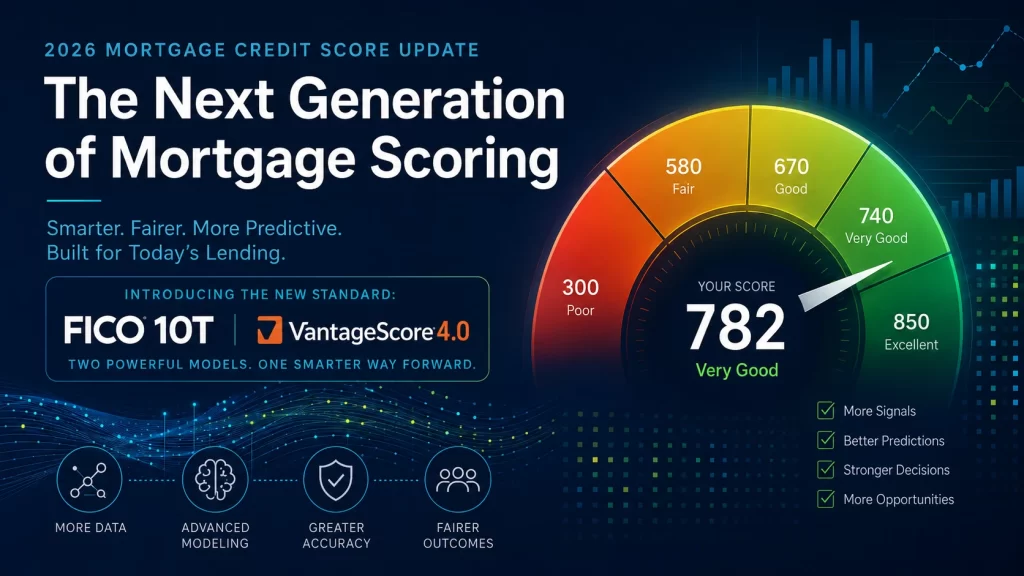
For the first time in over three decades, the mortgage industry is changing how it evaluates credit. Beginning in 2026, lenders selling loans to Fannie Mae and Freddie Mac can use FICO 10T and VantageScore 4.0 alongside the older Classic FICO models that have been the standard since the late 1990s. By the time the transition completes, this will be the most significant change to mortgage credit underwriting in a generation.
The biggest question for borrowers is simple: will this help or hurt my mortgage application? The answer is “it depends”, but for most borrowers, especially those who have been paying down debt steadily, paying rent on time without it counting on their credit report or recovering from past credit issues, the new models are likely to help. This guide walks through exactly what’s changing, when it’s happening, what FICO 10T and VantageScore 4.0 do differently than Classic FICO, what the changes mean for borrowers in specific situations and what you can do now to position yourself well for the new framework. As an independent wholesale mortgage broker that works with a large variety of lenders, we’ve been tracking this transition closely and helping borrowers navigate the new credit models.
What’s Actually Changing with the New Models and Why
For decades, mortgage lenders selling loans to Fannie Mae and Freddie Mac have been required to use specific older versions of the FICO credit score: FICO Score 2 from Equifax, FICO Score 4 from TransUnion, and FICO Score 5 from Experian. These models date back to 1998. They evaluate your credit using a “snapshot” approach looking at where your credit stands at a single point in time. They don’t consider rent payments, utility payments or how your debt patterns have changed over time. Until now, this has been the only way mortgage credit gets evaluated for conforming loans.
That’s changing. The Federal Housing Finance Agency (FHFA), which regulates Fannie Mae and Freddie Mac, validated two newer credit scoring models in October 2022: FICO 10T (the tenth iteration of FICO with trended data) and VantageScore 4.0 (a model jointly developed by the three major credit bureaus). These models use 24 months of credit history to build a more balanced picture of borrower behavior. They also incorporate alternative data like rent and utility payments, which Classic FICO ignores entirely. The transition to these new models is happening in phases through 2026 and beyond.
The Implementation Timeline
Understanding the timeline matters because the transition is happening unevenly. Different lenders are adopting at different speeds, and your credit score might be evaluated by the old model, the new model, or both depending on which lender you apply with. Here’s where things stand:
- October 2022: FHFA validated FICO 10T and VantageScore 4.0 for use by Fannie Mae and Freddie Mac.
- July 2024: Fannie Mae and Freddie Mac released historical VantageScore 4.0 credit scores covering tens of millions of past loans, allowing lenders to study how the new model compares to Classic FICO.
- Mid 2025: Approved lenders began delivering loans to Fannie Mae and Freddie Mac using VantageScore 4.0 alongside Classic FICO scores.
- April 2026: A joint FHFA and HUD announcement expanded the rollout, signaling broader implementation across the year.
- Summer 2026: Fannie Mae and Freddie Mac expect to publish historical FICO 10T scores, the same way they did for VantageScore 4.0 in 2024
- Late 2026 and beyond: Broader lender adoption of both new models is expected, with Classic FICO continuing as an approved option during the transition.
The practical takeaway is that 2026 is a transition year. Some lenders are using the new models, some are sticking with Classic FICO, and many will support both. The framework is no longer “everyone uses the same score”, it’s “lender choice within an approved set of models.” For borrowers, this means the lender you work with can affect which scores get evaluated.
How VantageScore 4.0 Differs From Classic FICO
VantageScore is a credit scoring model created jointly by the three major credit bureaus (Equifax, Experian, and TransUnion) in 2006. VantageScore 4.0, the current generation, takes a different approach to several aspects of credit scoring than FICO does and it’s now an approved model for mortgages sold to Fannie Mae and Freddie Mac.
Trended Data Built In From the Ground Up
The biggest mechanical difference is trended data. Classic FICO looks at your credit report as a single snapshot: what your balances are right now, what your utilization is right now and whether you have any current delinquencies. VantageScore 4.0 looks at the same data over the past 24 months. It can see whether you’ve been steadily paying down a high credit card balance over the past two years or whether your balances have been steadily growing. Two borrowers with the same current snapshot can score very differently under VantageScore 4.0 if their two year trajectories differ.
This rewards a specific borrower profile: someone who has been managing debt responsibly over time, even if their current snapshot looks similar to less disciplined borrowers. If you’ve been paying down credit card balances over the past 18 months, VantageScore 4.0 will recognize the trend in a way Classic FICO cannot. Conversely, if your balances have been creeping up even without late payments FICO 10T may be more cautious about you than VantageScore 4.0 is.
Alternative Data: Rent and Utilities Count
VantageScore 4.0 was specifically designed to incorporate alternative payment data such as rent, utilities, telecommunications and other recurring payments that don’t appear on traditional credit reports. When you opt into a rent reporting service, those payments can flow into your VantageScore 4.0 calculation in a meaningful way. For renters with strong payment histories who have thin credit files otherwise, VantageScore 4.0 can produce significantly higher scores than Classic FICO.
Better Scoring for Thin Credit Files
Classic FICO requires at least 6 months of credit history before it can generate a score. VantageScore 4.0 can score borrowers with as little as one month of credit history on at least one account reported within the past 24 months. This makes the new model substantially more inclusive for younger borrowers, recent immigrants and people who have historically avoided credit. If your credit file is thin enough that Classic FICO returns “insufficient credit” or “unscorable,” VantageScore 4.0 may give you a usable score.
Different Treatment of Paid Collections
VantageScore 4.0 ignores paid collections entirely. Once a collection account is paid off it stops affecting your VantageScore. Classic FICO continues to factor paid collections into your score (though the impact diminishes over time, and FICO 9 and later versions also reduced this weight). For borrowers who have paid off old collection accounts, VantageScore 4.0 generally produces better scores.
How FICO 10T Differs From Classic FICO
FICO 10T (the “T” stands for trended) is the tenth generation FICO model designed to address limitations in earlier versions and incorporate the kind of behavioral patterns that matter to modern lenders.
Trended Credit Data Over 24 Months
Like VantageScore 4.0, FICO 10T uses trended credit data analyzing 24 months of credit behavior rather than a snapshot. The mechanical effect is similar: borrowers who steadily pay down debt are rewarded and borrowers whose balances are growing get evaluated more cautiously. Some industry analysis suggests VantageScore 4.0 weights trended data slightly differently than FICO 10T, but for most borrowers the practical impact is similar.
Reduced Weight on Medical Collections
FICO 10T applies less weight to medical collections than Classic FICO does and ignores paid medical collections entirely. This continues a broader industry shift toward de-emphasizing medical debt that began with FICO 9 and accelerated in 2023 when the major credit bureaus stopped reporting paid medical collections altogether. For borrowers whose credit issues stem from medical bills, FICO 10T should produce noticeably better scores than Classic FICO.
Rental Payment Data When Available
FICO 10T can incorporate rental payment history when it’s reported to the credit bureaus through a verified service. This isn’t automatic. Your landlord typically isn’t reporting your rent payments to the bureaus on their own. You have to opt in through a service like Experian Boom, RentReporters, or Esusu (these are examples; we don’t endorse any specific service). For renters who have paid on time consistently for years, this can be a meaningful score boost that wasn’t previously available.
What This Actually Means for Different Borrower Situations
The new models help some borrowers more than others. Here’s how the changes are likely to affect specific borrower profiles:
The Steady Debt Payer
If you’ve been steadily paying down credit card balances or other revolving debt over the past 18 to 24 months, the new models will reward this pattern in a way Classic FICO cannot. Your trended data shows a clear improving trajectory. Under Classic FICO, your current snapshot might still show high enough utilization to suppress your score but under FICO 10T or VantageScore 4.0, the downward trend in your balances counters that and lifts your score. This is one of the cleanest “winner” profiles under the new models.
The Long Term Renter With Thin Credit
If you’ve paid rent on time for years but your credit file is otherwise thin with maybe one or two credit cards and no installment loans, Classic FICO has been undervaluing you. VantageScore 4.0 changes this if you opt into rent reporting. Even six to twelve months of reported on time rent payments can establish a meaningful payment history under the new model. For first time homebuyers who are otherwise financially responsible but lack the deep credit file traditional FICO favors this is a significant change.
The Borrower Recovering From Medical Debt
If your credit issues stem primarily from medical collections both new models treat your situation more favorably than Classic FICO. FICO 10T reduces the weight of medical collections; VantageScore 4.0 ignores paid medical collections entirely. Combined with the broader industry trend of removing small paid medical debts from credit reports altogether, borrowers with medical debt driven credit damage should see meaningful score improvements as the transition rolls out.
The Borrower With Recent Late Payments or Active Collections
The new models don’t help here and may not differ materially from Classic FICO. Recent missed payments, open collections, charge-offs within the past 12 to 24 months, all three models weight these heavily because they’re strongly predictive of default risk. The trended data approach can actually be slightly worse if your trajectory is negative (for example, balances rising, payment patterns deteriorating). The path forward for this profile is the same regardless of model: 12 or more months of consistent on-time payments to build a positive recent history.
The Borrower With a High Score But Rising Balances
If you have a 720 Classic FICO score but your credit card balances have been growing month over month for the past 12 months, FICO 10T and VantageScore 4.0 will see this trajectory and weight it more cautiously. Your trended pattern signals increasing risk that the snapshot doesn’t capture. Borrowers in this situation might find their new model scores running 10 to 30 points lower than their Classic FICO scores.
The Borrower Whose Score Issues Are Old
If your credit problems are 24 plus months in the past and your recent profile is clean, both new models will likely improve your score relative to Classic FICO. The trended data approach uses 24 months of history which means anything older than that contributes less weight. Combined with reduced emphasis on paid collections, borrowers whose past issues have aged out of the trended window typically score better under the new models than they did under Classic FICO.
How the New Models Connect to Other Recent Mortgage Changes
The 2026 credit scoring transition is happening at the same time as several other significant mortgage underwriting changes and they reinforce each other in ways worth understanding.
Fannie Mae’s November 2025 Removal of the 620 Minimum
In November 2025, Fannie Mae eliminated its longstanding 620 minimum credit score requirement for loans approved through Desktop Underwriter. This change made conventional loans technically available to borrowers below 620 for the first time in decades provided they have strong compensating factors. Combined with the new scoring models, the implication is significant: the rigid score based qualification framework that defined mortgage underwriting for decades is genuinely loosening. Borrowers who previously failed 620 score or higher test now have multiple paths forward depending on their full profile and which model their lender pulls. (For more on the Fannie Mae change and what it means for sub 620 borrowers, see our complete guide on getting a mortgage with bad credit.)
The Bi-Merge Credit Reporting Option
As part of the broader transition, FHFA also announced that the Enterprises will permit lenders to use bi-merge credit reporting (pulling reports from two of the three bureaus) instead of the traditional tri-merge approach (all three bureaus). Bi-merge reduces costs for borrowers and lenders. The transition to bi-merge is being aligned with the transition away from Classic FICO. Practically, this means some lenders may pull only two bureau reports during your application, while others continue pulling all three. The score they use to qualify you will come from those reports.
What This Adds Up To for Borrowers
Taken together, the 2026 changes represent a genuine modernization of how mortgages get underwritten. The credit score is no longer a single rigid number determining your fate. Lenders can now choose among approved scoring models, the models themselves are more sophisticated, and the underlying minimum score requirements have softened. For borrowers with imperfect credit, post-bankruptcy histories, or thin credit files, the new framework is meaningfully more forgiving than the one that’s been standard for the past 25 years.
Practical Questions to Ask Your Lender in 2026
Because the transition is happening at different speeds at different lenders, the questions you ask during the application process matter more than they used to. Specific questions worth asking before you choose a lender:
Which Scoring Models Do You Use?
Some lenders are using Classic FICO only. Some are running both Classic FICO and VantageScore 4.0. A few are starting to incorporate FICO 10T as historical data becomes available. The lender’s answer affects which version of your credit gets evaluated. If you’ve been managing debt steadily over 24 months, a lender using a trended data model will see your improvement; a lender using Classic FICO won’t.
Will Rent Reporting on My Credit File Be Considered?
If you’ve enrolled in a rent reporting service, ask whether your lender’s scoring approach will incorporate that data. If they’re using VantageScore 4.0 or FICO 10T, the answer is generally yes. If they’re using Classic FICO, the answer is no. Knowing this in advance helps you choose a lender whose scoring approach matches your strengths.
How Are You Handling Score Differences Between Models?
When two scoring models produce different scores for the same borrower (which is common, especially during the transition), lenders need to decide which score to use. Different lenders have different policies. Some use the lower score for conservative underwriting; some use the higher; some take the middle of available scores. This is exactly the kind of question a wholesale mortgage broker can answer for multiple lenders simultaneously. At Alpine Mortgage, for example, we work with lenders running VantageScore 4.0 alongside Classic FICO and can submit your file using whichever score qualifies you better.
Why Working With a Wholesale Broker Helps Navigate the Transition
The credit scoring transition has unintentionally made the wholesale broker channel more valuable than it has been in decades. Here’s why: when there was one scoring model used universally for mortgages, the lender choice mattered less for credit related decisions. Now, with multiple approved models in active use across different lenders, the same borrower can have meaningfully different qualification outcomes at different lenders. A 615 Classic FICO score might be declined at one lender but approved at another lender using VantageScore 4.0 with the borrower’s rent reporting included. A borrower whose 24 month trended trajectory shows strong improvement might score 30 points higher under FICO 10T than under Classic FICO and a lender already using FICO 10T might offer them a pricing tier that a Classic FICO lender wouldn’t.
Retail banks generally use whichever scoring approach their internal systems are configured for and don’t shop alternatives. Wholesale brokers shop borrower applications across multiple lenders simultaneously including lenders using different scoring models. For borrowers whose qualification is borderline under any single scoring framework, lender shopping can be the difference between approval and denial.
Alpine Mortgage works with lenders that are running VantageScore 4.0 alongside Classic FICO under the new framework. For your application, we can pull both your Classic FICO and VantageScore 4.0 scores and submit your file to the lender using whichever score qualifies you better. For a borrower whose 24 month trajectory of debt paydown produces a higher VantageScore 4.0 than their Classic FICO, this can mean access to better pricing tiers, lower minimum score requirements or approval where a Classic FICO only lender would have declined. For a borrower whose Classic FICO happens to be higher we go with that one. You don’t have to guess which scoring model favors you. We can run both and pick the better outcome.
As an independent wholesale broker, Alpine Mortgage works with lenders across the full spectrum of scoring approaches. We’ve helped borrowers navigate complex credit situations under both old and new models, and we’d be glad to review your specific scenario. For more on related topics, see our guides on getting a mortgage with bad credit.
Important disclaimer. This article is provided for general informational and educational purposes only. It does not constitute legal advice, tax advice, or financial advice. Credit scoring model implementation timelines, lender adoption schedules and underwriting standards continue to evolve as the 2026 transition progresses. Information in this article reflects publicly available guidance from FHFA, Fannie Mae, Freddie Mac and other sources as of publication; specific lender practices may differ. Before making credit or mortgage decisions, consult with a licensed mortgage professional who can review your specific situation. Mortgage products referenced in this article are subject to credit approval, underwriting guidelines and program availability. Rates, terms, and program guidelines are subject to change without notice.
Frequently Asked Questions
When will all mortgage lenders use FICO 10T and VantageScore 4.0?
There’s no fixed deadline for full adoption. The transition began in mid 2025 with VantageScore 4.0 acceptance by Fannie Mae and Freddie Mac, expanded with the April 2026 FHFA and HUD announcement, and is expected to continue through 2026 and beyond. Different lenders are adopting at different speeds, and most lenders will eventually support both Classic FICO and the new models simultaneously. At Alpine Mortgage we work with lenders running VantageScore 4.0 alongside Classic FICO and can submit your file using whichever score qualifies you better.
Will my credit score change because of the new models?
Your underlying credit report data isn’t changing. What’s changing is how scoring models interpret that data. Most borrowers will see their scores under FICO 10T or VantageScore 4.0 differ from their Classic FICO score. Borrowers with steady debt paydown patterns, paid medical collections or strong rent payment histories tend to score higher under the new models. Borrowers with rising balances or recent credit issues may score similarly or slightly lower.
How do I know which scoring model my lender will use?
Ask directly during your initial conversation. Lenders generally know which scoring models they pull and can tell you. As of 2026, most lenders are still primarily using Classic FICO, with a growing minority using VantageScore 4.0 alongside Classic FICO. FICO 10T adoption is expected to expand significantly after Fannie Mae and Freddie Mac publish historical data in summer 2026.
Does enrolling in a rent reporting service guarantee a higher score?
No. Rent reporting can boost scores under VantageScore 4.0 and FICO 10T, but the impact varies based on your existing credit profile. Borrowers with thin credit files or limited positive history see the largest gains. Borrowers with already strong credit profiles see modest gains. Rent reporting also doesn’t affect Classic FICO scores at all so the benefit only applies if your lender uses one of the new models.